Because there is an incredible need for physiotherapists who know the Pelvic Floor and its Dysfunctions. A “valuable” field of knowledge with scientific interest, huge demand and effective treatment.
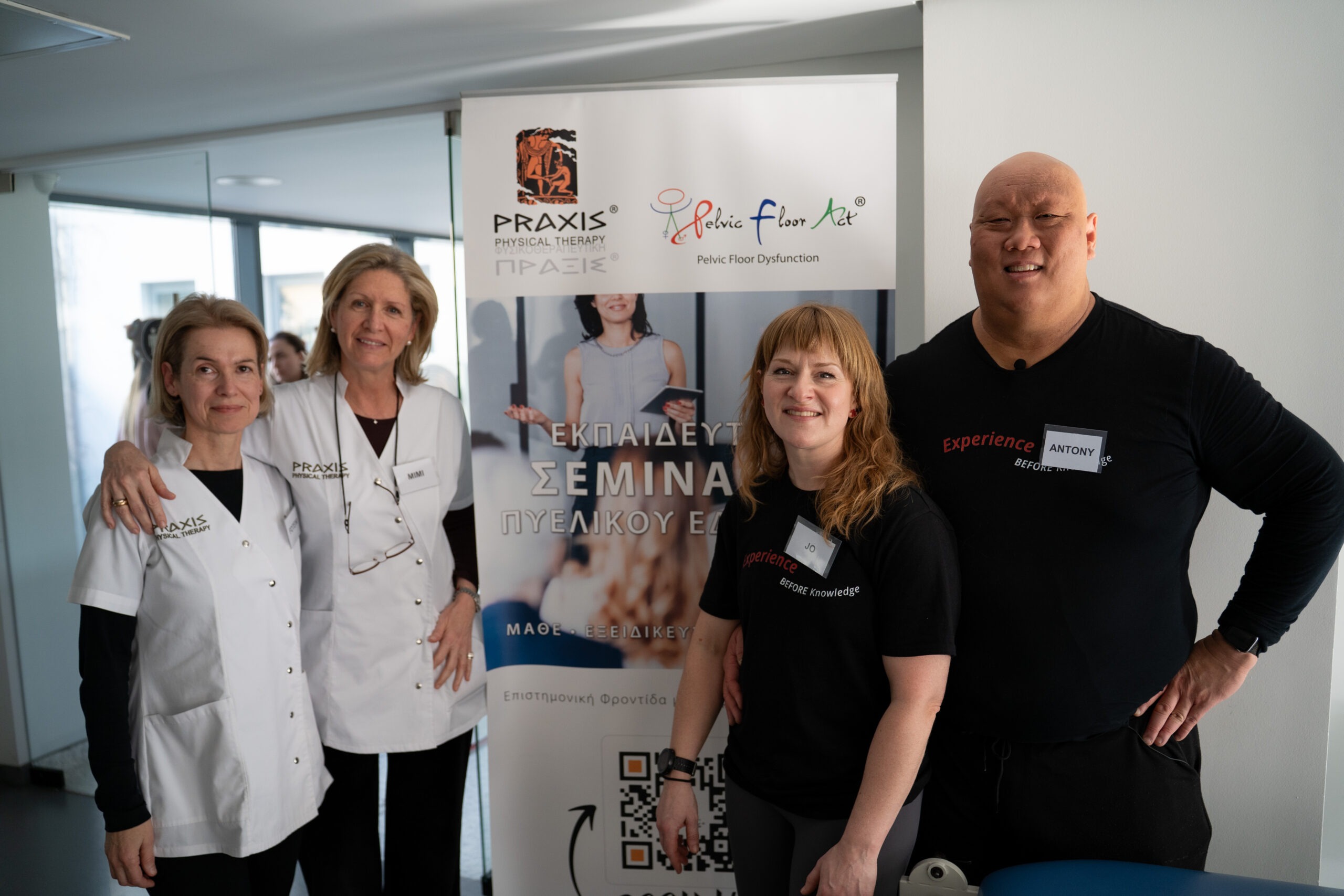
On the first weekend of November 2 & 3 November 2024) the physiotherapy centre PT PRAXIS® starts a series of seminars on the “Pelvic Floor”. The 1st seminar is addressed to physiotherapists with relevant knowledge of the Pelvic Floor who want to deepen their knowledge in the areas: Proper Pelvic Floor Assessment, Clinical Reasoning.
The shocking statistics
- 50% to 75% of women after breast cancer do not talk about early menopause syndrome and symptoms of dyspareunia, urinary incontinence and vaginal dryness[1]
- 50% of women during pregnancy and postpartum experience Pelvic Floor dysfunctions
- 3% to 11% of men and 3% to 17% of women will experience urinary incontinence
- 16% of adults in the US experience fecal incontinence, 8% in Asia, China and India and 28% in Japan.
- One-third of women will experience pelvic organ prolapse to some degree at some point in their lives.
- In women, under the umbrella of symptoms included in the term “sexual dysfunction”, 10% to 20% will experience dyspareunia (pain during sex), 1% to 7% vaginal pain and 10% to 15% anorgasmia.
- In men, pelvic pain will cause symptoms of sexual dysfunction. 30% of men will experience erectile dysfunction, rising to over 50% in men over 50 years of age, and ejaculatory dysfunction (20% to 30% early ejaculation, 1% to 4% delayed ejaculation).
- Pelvic pain occurs in 15% to 20% of women, while chronic pelvic pain occurs in a significant number of men, with implications for their quality of life, mental health, daily activities and sexual function.
What is the role of physiotherapy in the treatment of Pelvic Floor dysfunctions?
The role of physiotherapy is common internationally. It is defined by the World Physiotherapy Organisation (World Physiotherapy) and follows International Guidelines. Clinical practice in all countries – including Greece – follows guidelines based on scientific evidence and clinical experience.
What are the World Physical Therapy Organization’s guidelines for the Pelvic Floor?
The International Organization of Physical Therapists in Pelvic and Women’s Health (IOPPWH) is one of the departments of the World Physical Therapy Organization and is concerned with women, but also men and children. It was founded in 1999 and was the 3rd scientific department.
How can a Pelvic Floor physiotherapist help a woman, during pregnancy and after childbirth?
In order for the physiotherapist to address Pelvic Floor dysfunctions during pregnancy and postpartum, the physiotherapist must have a good understanding of the anatomy and functional anatomy of the Pelvic Floor. Also, the Pelvic Floor physiotherapist knows and recognizes its dysfunctions: bladder dysfunction, pelvic organ prolapse, bowel dysfunction, sexual dysfunction and pelvic pain.
How can a physiotherapist who knows about Pelvic Floor rehabilitation help?
In case there is increased muscle tone (tightness) in the Pelvic Floor muscles as in cases of sexual dysfunction or pelvic pain, the physiotherapist should know how to relax the muscle tissue, and if there is relaxation as in cases of urinary/faecal incontinence or prolapse, the Pelvic Floor physiotherapist is asked to create a program to strengthen the muscles of the area.
Why is it important for physiotherapists to be informed and trained in the field of Pelvic Floor?
In Europe, Australia and the USA, one in four women after childbirth or menopause have Pelvic Floor Dysfunction, with at least one of the five symptoms resulting from it. Knowledge helps not only in treatment but also in prevention. This knowledge can be safely spread by physiotherapists who know about the Pelvic Floor and its dysfunctions and can intervene either by helping the woman, man or child to prevent or deal with their effects.
How effectively can physiotherapy “intervene” in the perception of the correct execution of a Pelvic Floor muscle retraining program?
In the 100 people who perform contractions of the Pelvic Floor muscles:
- 50% make an ideal effort
- 11% efficient
- 14% ineffective
- 25% performs Valsalva, i.e. increases intra-abdominal pressure. The Valsalva is doing exactly what it should not do.
Research has shown that with just one (1) session of physical therapy, 70% of people who see a physical therapist are able to perform proper Pelvic Floor muscle contraction.
How effectively can physiotherapy “prevent” Pelvic Floor dysfunctions during pregnancy and postpartum?
Research has shown that providing a supervised and intensive Pelvic Floor muscle training program by a physical therapist to continent pregnant women during pregnancy prevents urinary incontinence during pregnancy and postpartum.
What does a woman or man with symptoms of Pelvic Floor Dysfunction expect from a physiotherapist with specific knowledge in this field?
Taking a detailed history, Pelvic Floor awareness training, vaginal and/or rectal muscle digital assessment and clinical reasoning in order to come up with a personalized Pelvic Floor muscle training program.
[1] https://www.ptpraxis.gr/%cf%84%ce%bf-%cf%86%cf%85%cf%83%ce%b9%ce%ba%ce%bf%ce%b8%ce%b5%cf%81%ce%b1%cf%80%ce%b5%cf%85%cf%84%ce%ae%cf%81%ce%b9%ce%bf-%cf%86-%ce%b8-%cf%80%cf%81%ce%b1%ce%be%ce%b9%cf%83-%cf%83%cf%84%ce%b7%ce%bd/